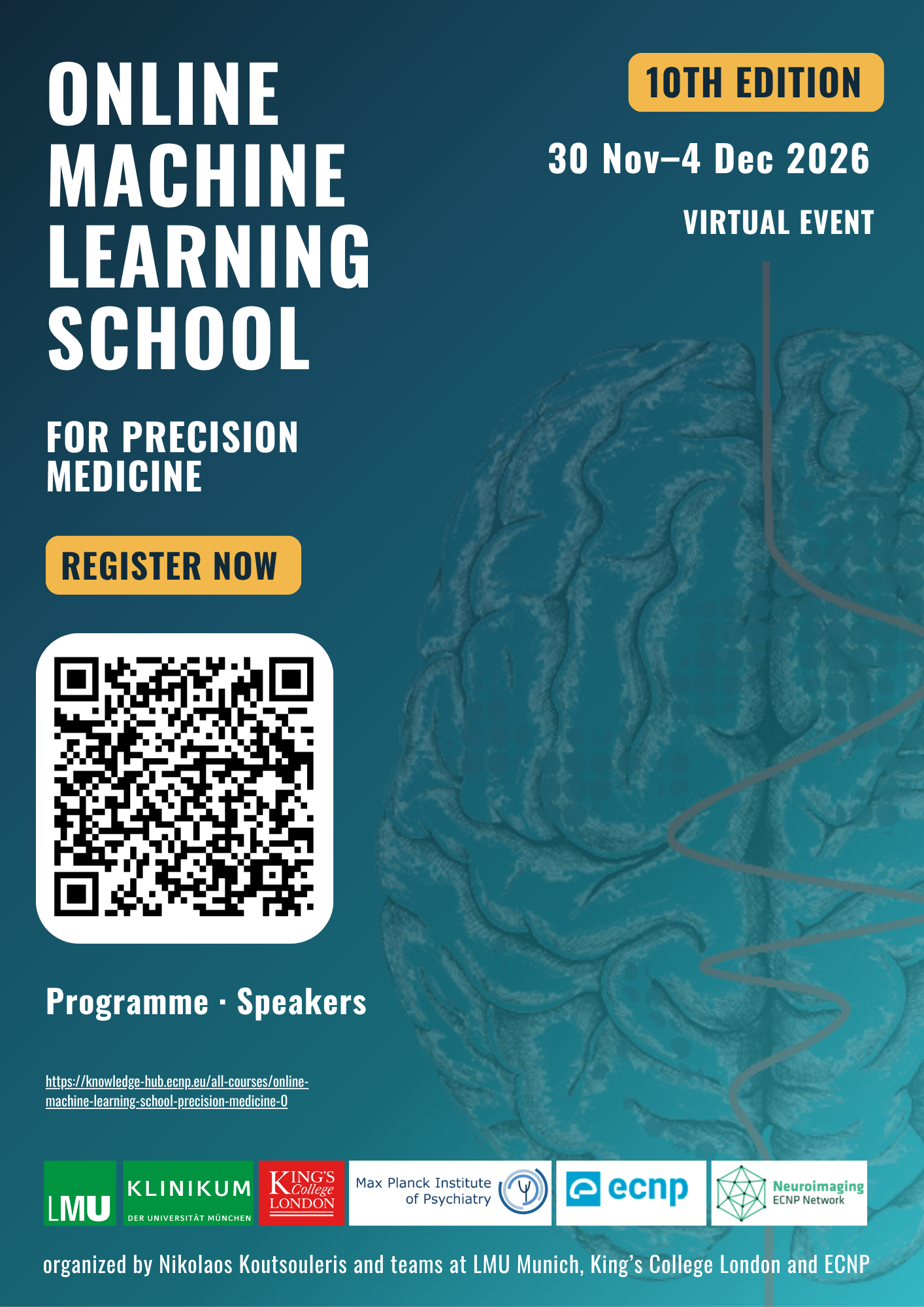
The Online Machine Learning School for Precision Medicine provides comprehensive training on machine learning (ML) methodologies for beginners, tailored specifically to clinical research applications in psychiatry and neuroscience. This fully online course will take place from 30 November to 4 December 2026, running daily from 09.30 to 17.00 CET.
The programme is designed to enhance participants' understanding of ML concepts through practical sessions and theoretical discussions. The course covers fundamental ML topics, including nested cross-validation, strategies to mitigate overfitting, external validation processes, and interpretability through explainable AI (XAI). It also introduces modern deep-learning architectures – including transformers, new foundation models, and large language models (LLMs) – and what they mean for clinical and neuroscientific data, at a level accessible to non-programmers. Participants will also explore the TRIPOD-AI guidelines to enhance the reporting quality and transparency of ML research findings. Additional attention is devoted to challenges frequently encountered in psychiatric research, such as site-correction and data fusion techniques. The curriculum incorporates perspectives from guest speakers who discuss ethical, practical, and regulatory issues relevant to integrating ML into clinical practice.
The hands-on components use NeuroMiner 2.0, the new release of the user-friendly ML toolbox developed for clinical neuroscience and neuroimaging research. NeuroMiner 2.0 introduces a web-based interface, an interactive Workbench, and an integrated LLM assistant that helps users configure and interpret analysis pipelines – while still requiring the analyst to understand and interrogate every model they build.
Two participation tracks are available to accommodate different learning needs:
- Basic track: access to seminars and expert lectures only.
- In-depth track: access to seminars, expert lectures, hands-on tutorials and interactive workshops using NeuroMiner 2.0.
No prior coding knowledge is required, enabling broad accessibility to clinicians and researchers seeking to effectively incorporate ML into their work. The course is applicable to participants working with a wide variety of data, including clinical, neuroimaging, and genetic data.
This course is organised by Nikolaos Koutsouleris, Germany, and collaborators from LMU Munich, King’s College London, and the ECNP Neuroimaging Network.